
At a glance
- When two operating modes share a tank or other critical resource, qualify the shared path and each mode as one system.
- Treat mass and volume savings as a design hypothesis until mode switching, isolation and fault propagation are demonstrated in operation.
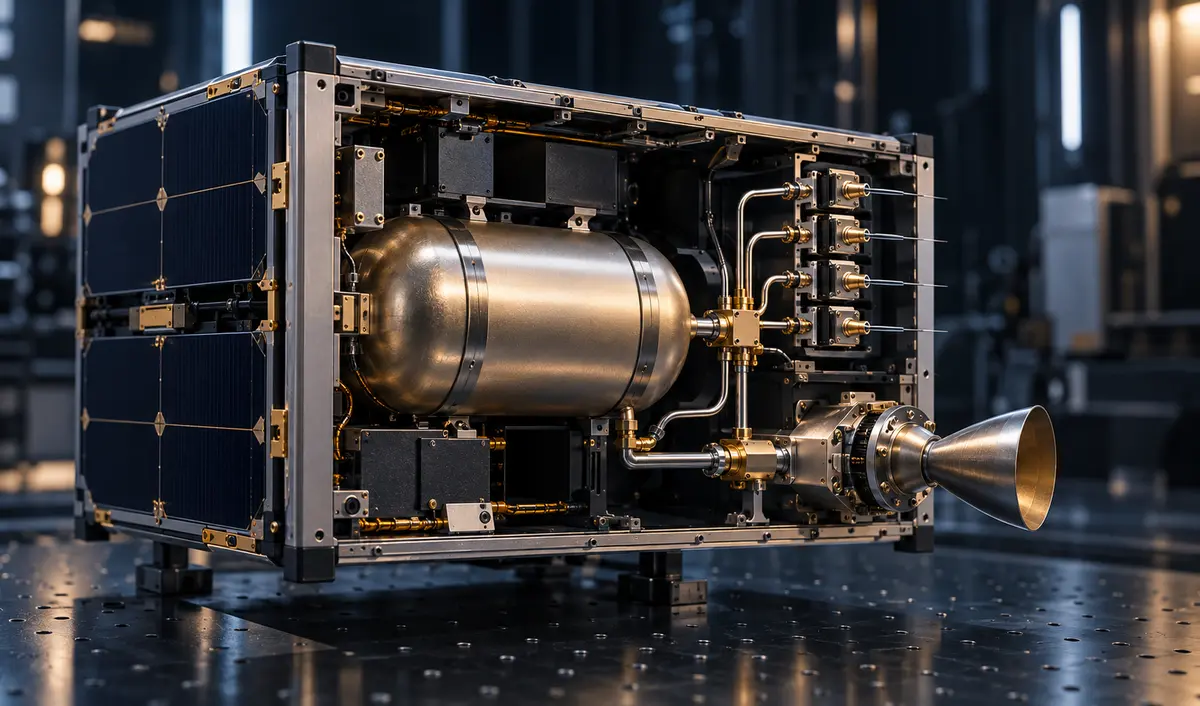
A NASA technology article by Joel Wallace dated 25 September 2026 describes a 6-U CubeSat built to test two forms of propulsion from one propellant tank. The spacecraft, roughly the size of a large shoebox, feeds a high-thrust combustion engine and low-thrust electrospray thrusters with the same non-toxic ASCENT propellant. Conventional spacecraft may use separate tanks and plumbing for rapid and efficient manoeuvres; the combined architecture is intended to free mass and volume for payloads.
The article reports that the flight hardware has completed helium leak testing in a vacuum chamber, thermal-vacuum testing and a spin test. Those checks address different risks: seal integrity in the shared fuel system, operation across vacuum and temperature conditions, and the spacecraft's balance and centre of gravity. Final system checkouts and solar-array integration remain before shipment for launch.
The planned nine-month demonstration will begin after deployment into an orbit about 325 miles above Earth. Following checkout, operators intend to perform short chemical and electric manoeuvres, then alternate between orbit-raising and orbit-lowering operations using the two propulsion modes. The article sets out the test sequence, but it does not yet provide in-orbit performance, reliability or cost results.
Dunes Bureau interpretation: consolidation changes where an engineering team should look for failure. A buyer or programme manager should test each mode independently, then test the common tank, valves, control logic and transitions as a connected system. The acceptance plan should include loss of one mode, leakage or pressure drift in the shared path, an interrupted mode change and the ability to recover without harming the second mode. The same logic applies when an industrial product replaces two subsystems with one shared power source, controller or fluid circuit.
The practical promise is fewer tanks and less plumbing, not a proven universal saving. The NASA update does not quantify launch-cost reduction, payload gain or service life, and the mission has not yet demonstrated the architecture in orbit. Commercial teams should therefore separate verified ground-test evidence from expected system benefits and wait for operating data before treating integration as validation.
Sources
NASA Tests Dual Mode Propulsion CubeSat Ahead of Launch ↗
Joel Wallace · National Aeronautics and Space Administration. Accessed 2026-09-26. NASA media usage and AI source-disclosure guidelines.