
At a glance
- Qualify a quantum measurement against the accuracy required by the application, not a generic instruction to use a strong reference pulse.
- Include the measured signal state, detector noise and downstream conditional operation in the hardware acceptance test.
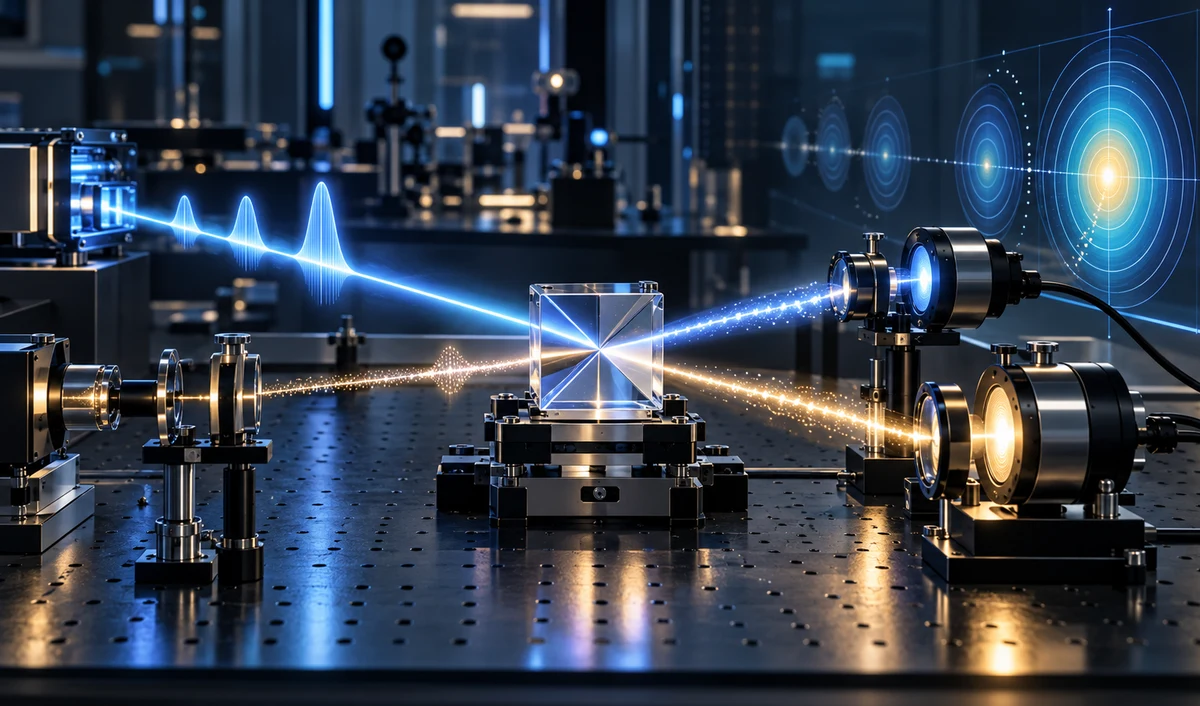
A NIST-led research paper dated 23 September 2026 tackles a practical limitation in homodyne measurement, a standard way to read the amplitude and phase components of quantum light. The setup combines a quantum signal with a known reference pulse, called a local oscillator, at a beam splitter. Two detectors measure the outputs and their difference provides the result. The reference pulse is finite, however, while the ideal measurement used in theory assumes a limiting case.
Laboratories often manage that gap with a broad rule: make the local oscillator much stronger than the signal. The paper explains why that rule is incomplete. The power required depends on what the measurement is meant to support, the photon-number properties of the signal, detector noise and whether the result will control a later operation. A setting adequate for estimating one statistic may not be adequate for preserving the state needed by another part of a quantum process.
The researchers derive lower bounds on fidelity, a measure of how close the real post-measurement result is to an ideal reference. The bounds cover both the recorded outcome and quantum modes that remain unmeasured. They also cover actions conditioned on that outcome, including continuous-variable quantum teleportation and error correction. For one error-correction example, the authors use the bounds to choose a local-oscillator amplitude that keeps added error small without applying unnecessarily large optical power.
Dunes Bureau interpretation: a buyer or engineering team should turn this result into a qualification structure. State the operation the measurement must enable, define the minimum acceptable fidelity or error contribution, record the signal-state assumptions and detector noise, and calculate the reference-pulse range that meets the requirement. Then test the assembled system across that range. The useful question is not whether the detector performs homodyne measurement, but how closely the complete measurement chain behaves like the model used by the application.
This is theoretical and simulation-supported research, not evidence of a commercial product, universal hardware threshold or near-term economic return. The paper says its bounds are conservative and that some dependences are not optimal. Their value is narrower: they make an important approximation measurable. Product teams would still need experimental validation, stability data and a system-level error budget before treating the method as an acceptance standard.
Sources
Quantified convergence of general homodyne measurements with applications to continuous variable quantum computing ↗
Emanuel Knill, Ezad Shojaee, James R. van Meter, Akira Kyle and Scott Glancy · National Institute of Standards and Technology. Accessed 2026-09-25. Citation and factual reporting only; no journal content reproduced.