
At a glance
- Earth’s centre of mass moves as water and air shift between regions.
- High-precision users should include reference-frame uncertainty in their positioning error budget.
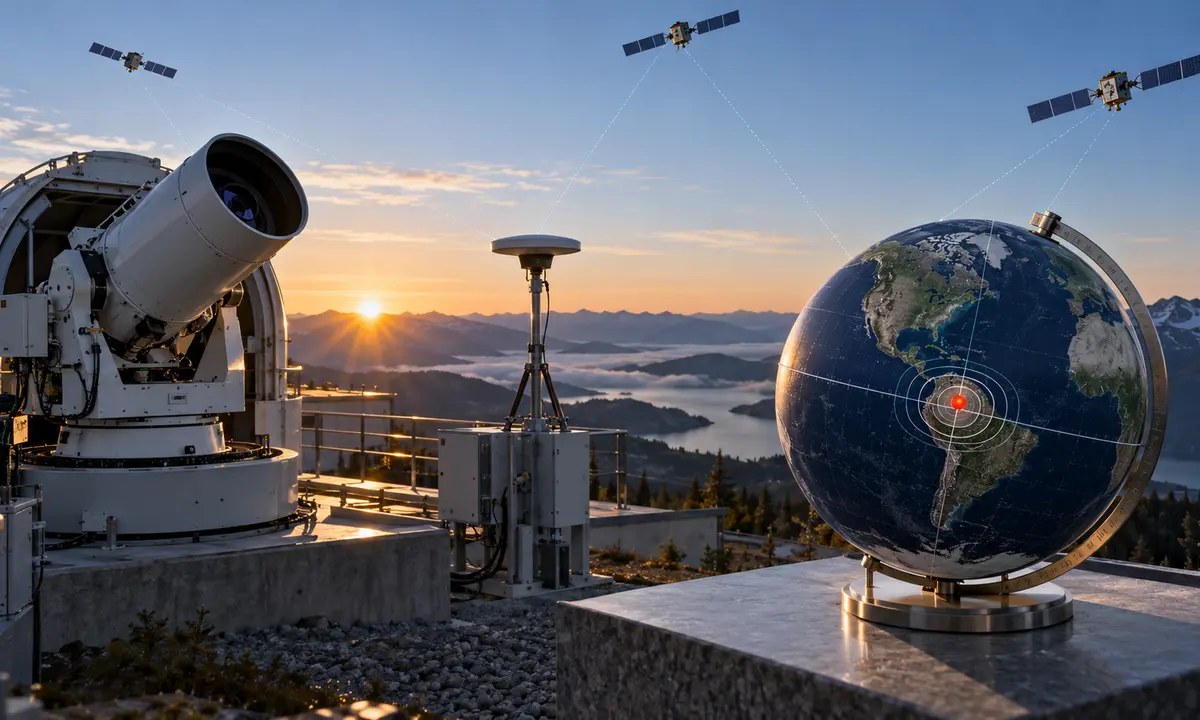
A navigation coordinate can look fixed even when its reference point is moving. Sally Younger’s Jet Propulsion Laboratory report, published on 16 September 2026, describes a new technique for estimating seasonal shifts in Earth’s centre of mass relative to its geometric centre. The movement is measured in millimetres, but the reference point matters to satellite navigation and elevation measurements.
The method combines laser ranging with GPS tracking and orbital data from several low-Earth-orbit satellites. It also accounts for the way water and ice loads deform Earth’s crust and move ground stations. The report notes that international estimates made in 2017 and 2023 differ by 7 millimetres, nearly as much as the seasonal motion being measured.
Dunes Bureau interpretation: organisations buying centimetre-sensitive positioning should treat the reference frame as part of the data pipeline, not as invisible background. A procurement test can record which frame and correction model a service uses, how often those inputs are updated, and how their uncertainty enters the application’s total error budget. That is relevant to tasks such as surveying, precision agriculture and logistics where small errors can accumulate across systems.
This is not evidence that ordinary navigation suddenly became unreliable, nor does the report quantify a commercial performance gain. The method is a research result. Its practical value will depend on how reference-frame authorities and positioning providers validate and incorporate it into operational products.
Sources
NASA Watches Earth’s Weight, Finds Center of Mass ↗
Sally Younger · NASA Jet Propulsion Laboratory. Accessed 2026-09-17. NASA media usage and AI source-disclosure guidelines.