
At a glance
- A plausible failure mechanism is not automatically the dominant explanation: the required temperature, moisture state and depressurisation path must all be demonstrated.
- Fire-testing programmes should measure heat, moisture and pore-pressure behaviour together rather than infer cause from the visible spall alone.
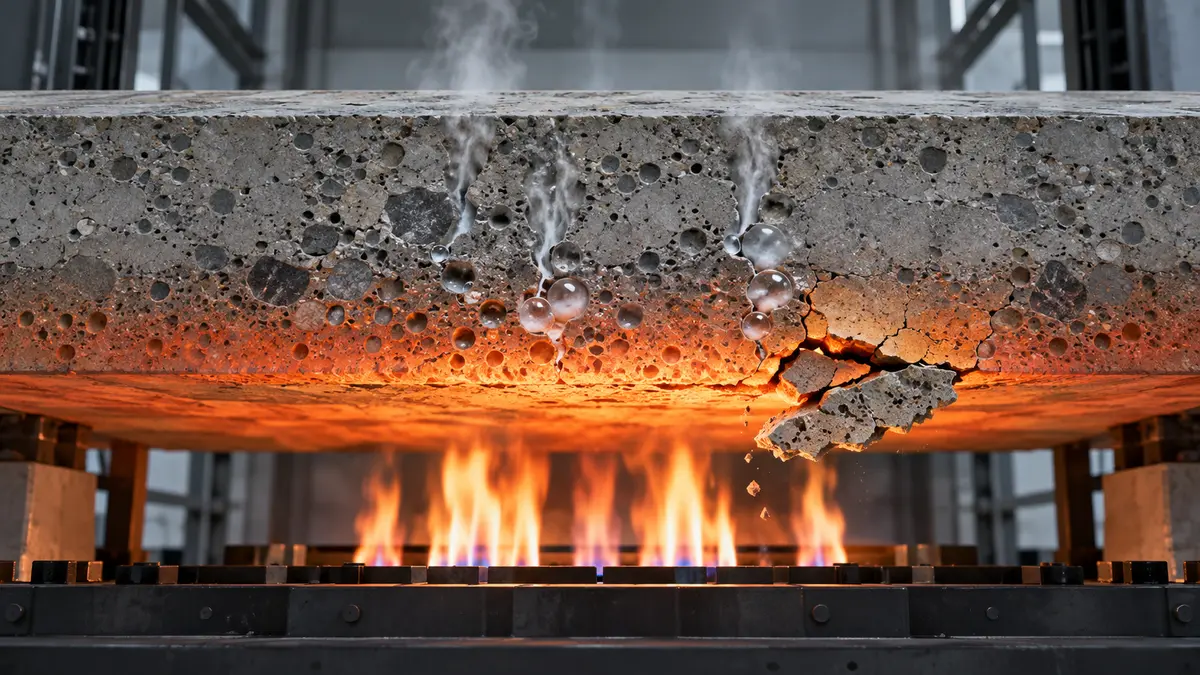
NIST published Technical Note 2385 on 24 September 2026. Jiann Yang examines whether a boiling-liquid expanding-vapour event, or BLEVE, could help explain fire-induced concrete spalling—the sudden ejection of material from a heated surface. The study treats water trapped inside a heated concrete region as an idealised closed system and asks which thermodynamic states could permit a rapid liquid-to-vapour transition after depressurisation.
The calculation finds a tightly constrained window rather than a general explanation. Liquid water must still be present, the trapped region must be at least partly liquid-filled, and depressurisation must be rapid. In the model, the favourable temperature range runs from 597 kelvin to water's 641.7-kelvin critical point. If only water vapour remains, the proposed event cannot occur. The paper notes that reported surface temperatures for fire-induced spalling span a wider 250 to 420 degrees Celsius, so the internal state cannot be inferred from surface temperature alone.
Dunes Bureau interpretation: an engineering investigation should separate three questions. Did heating and moisture transport create a liquid-bearing pocket? Did its pressure and temperature enter the narrow region identified by the model? Did cracking or rupture release pressure quickly enough? A post-fire observation of spalling answers none of those questions on its own.
For owners, designers and testing laboratories, the practical lesson is to preserve mechanism-specific evidence. A useful test plan would record heating rate, concrete composition and curing, moisture condition, specimen dimensions, internal temperature and pore pressure, together with the time and location of cracking. Comparing those measurements with the model is more informative than assigning every violent spall to steam pressure or to a single named mechanism.
The NIST work is a thermodynamic analysis, not a validation that BLEVE caused a particular structural failure. It deliberately does not model how water accumulates, how coupled heat and moisture move through concrete, or how rapidly a real crack depressurises the pore. The result therefore narrows one hypothesis; it does not replace fire testing, structural assessment or the broader thermo-hydro-mechanical analysis described in the literature.
Sources
On concrete spalling – BLEVE or no BLEVE ↗
Jiann C. Yang · National Institute of Standards and Technology. Accessed 2026-09-27. NIST Technical Series reuse terms.