
At a glance
- Treat a change in specimen size or fixture as a new measurement configuration that requires validation.
- Separate evidence that equipment can accept a sample from evidence that its readings remain repeatable and comparable.
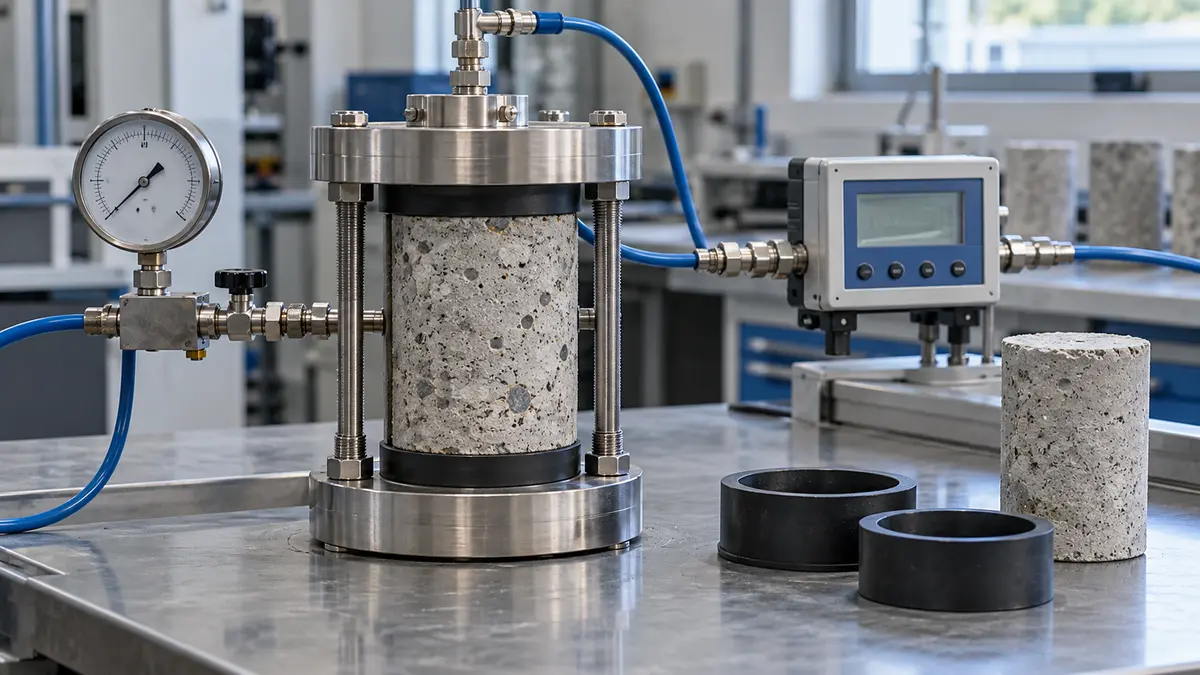
NIST published Technical Note 2382 on 24 September 2026. Stephanie Watson, Ashley Carey and Benjamin Johnsson examined a commercial air-permeability system used on concrete cores. The immediate research context is concrete containing pyrrhotite: the mineral can oxidise when exposed to oxygen and water, and NIST is studying whether sealants that restrict that exposure could delay deterioration in structures that have not yet shown damage.
Air permeability is being evaluated as one possible way to characterise how well those sealants perform. The original apparatus was designed for 152.4-millimetre, or six-inch, cores. The researchers also modified and tested it for 101.6-millimetre, or four-inch, cores, a common size for laboratory and field-cast concrete specimens. The report distinguishes validation of the as-received equipment from validation of the retrofitted configuration.
Dunes Bureau interpretation: the useful management lesson is that physical compatibility is not measurement equivalence. When a laboratory changes specimen diameter, adapter, seal or flow path, the change can affect leakage, pressure conditions and the calculation behind the result. A validation plan should therefore record the modified configuration, test repeatability, examine expected material trends and compare results against the established setup where possible.
For buyers of testing services, a report should identify the specimen dimensions and preconditioning, the fixture or adapter used, the pressure and flow-measurement method, and the evidence supporting the modified setup. This matters when results from different laboratories or projects are compared: a shared test name does not guarantee that the measurement systems were configured or validated in the same way.
The study does not establish that a sealant will prevent structural damage, set a universal acceptance threshold or endorse a commercial instrument. It documents equipment validation for a research programme. Decisions about an existing structure still require qualified inspection, material assessment and engineering judgment; the business implication here is narrower—adapted measurement systems need evidence before their outputs are treated as comparable.
Sources
Evaluation and Modification of Commercial Equipment to Evaluate Air Permeability of Concrete ↗
Stephanie S. Watson, Ashley S. Carey and Benjamin Johnsson · National Institute of Standards and Technology. Accessed 2026-09-26. NIST Technical Series reuse terms.