
At a glance
- A new wind-tunnel application measures changing pressure on a moving reference wing; it is not a flight demonstration of a commercial aircraft.
- Ask how the measurements will change a design decision, and which operating conditions still need validation.
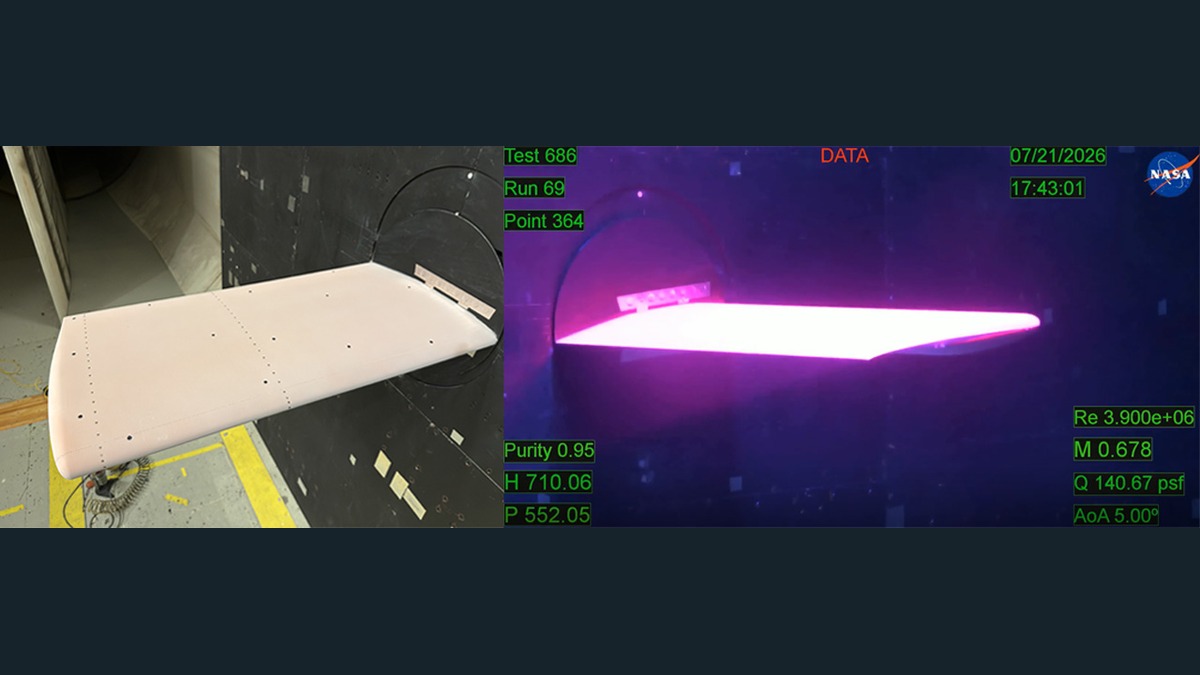
Brandon Ingram’s NASA report published on 2 October 2026 describes a new application of unsteady pressure-sensitive paint in Langley’s Transonic Dynamics Tunnel. The technique was used on a large, freely moving model in a low-oxygen environment for the first time. The Benchmark Supercritical Wing is a reference shape for improving computer models, rather than a particular commercial aircraft design.
Under ultraviolet illumination, the coating’s brightness varies with air pressure. High-speed cameras record those changes, turning the wing’s surface into a source of measurements for simulations. The reported advance creates a route to further tests of flexible aircraft models that bend during flight. The update does not establish a fuel-saving percentage, a production timetable or an airline operating benefit.
The measurement method itself is older. Jim Banke’s NASA explainer, published on 3 July 2025, contrasts paint-based surface measurements with conventional readings from individual pressure taps. It also describes cases where processed results became available within 20 minutes, allowing researchers to adjust a test while it was still under way. That earlier timing is context for the technology, not a turnaround time demonstrated in the new wing report.
Dunes Bureau interpretation: the useful business question is which design uncertainty becomes cheaper to resolve. A more detailed pressure map could help an engineering team identify where a simulation needs correction, choose its next test condition or investigate a local load that sparse measurements would leave uncertain. Any reduction in redesign or repeat testing remains a benefit to measure, not an outcome established by this announcement.
For manufacturers commissioning such work, the brief should connect each measurement to a decision. It should specify the conditions represented, the uncertainty in the result, the comparison with existing measurements and what would justify changing the design. Results obtained on a reference wing should not be assumed to transfer unchanged to a different geometry, material or flight condition.
For Gulf aviation businesses assessing future aircraft technologies, this is an upstream research milestone. It strengthens the route from a wind-tunnel observation to a better engineering model. A commercial case would still need evidence that the resulting design performs as intended, alongside manufacturing, maintenance and operating costs. Those later questions remain open.
Sources
NASA Model Wing Lights Up During First Pressure Sensitive Paint Tests — 2 October 2026 ↗
Brandon Ingram · NASA. Accessed 2026-10-03. NASA factual commercial editorial usage and AI source-disclosure guidelines; third-party exceptions checked.
NASA Advances Pressure Sensitive Paint Research Capability — 3 July 2025; updated 22 June 2026 ↗
Jim Banke · NASA. Accessed 2026-10-03. NASA factual editorial usage and AI source-disclosure guidelines; no source imagery reused.