
At a glance
- L3Harris will design, assemble and integrate an Engineering Test Unit that NASA describes as the final step before future flight-hardware production.
- The all-glass telescope uses Zerodur, a ceramic-glass composite selected for dimensional stability across a wide temperature range.
- The new unit is a qualification milestone, not evidence that the flight telescopes are complete or that the mid-2030s launch schedule is guaranteed.
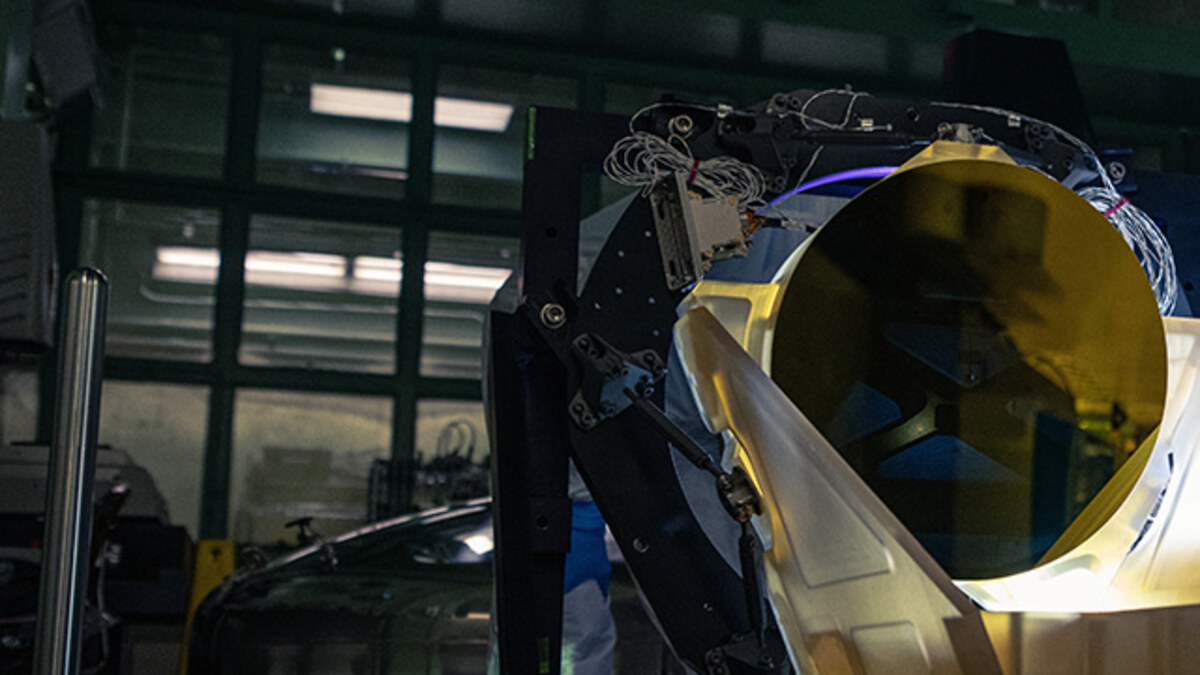
NASA reported on 8 October 2026 that L3Harris Technologies will design, assemble and integrate a new Engineering Test Unit for the Laser Interferometer Space Antenna, or LISA. NASA calls the unit the final step toward future production of flight hardware and the last pre-flight telescope before its first optical telescope delivery to the European Space Agency.
The sequence matters more than the label. L3Harris delivered an engineering-development prototype in 2024, and NASA says that prototype has undergone rigorous testing. In June 2026 the team delivered a metal structural model. The new test unit is intended to carry those lessons into an optical telescope assembled and integrated through the process expected to precede flight production.
The telescope is designed entirely from Zerodur, an amber-coloured ceramic-glass composite that resists shape change across a wide temperature range. Its mirror is gold-coated. That stability supports a measurement system in which three spacecraft, arranged roughly 1.6 million miles apart on each side, exchange infrared laser signals and detect minute changes in their relative distances.
What the test unit proves—and what it does not
Dunes Bureau interpretation: for suppliers and programme managers, the Engineering Test Unit is a manufacturing gate rather than a victory lap. A useful review should ask whether the build sequence, tooling, optical alignment, interfaces and acceptance evidence can be repeated for flight units—not merely whether one prototype survived a test campaign.
The milestone also sets clear limits on what can be claimed. NASA says LISA is slated for launch in the mid-2030s, but the 8 October update does not say the flight telescopes are built, disclose an award value or guarantee the launch timetable. It describes progress from development hardware toward a production-ready process.
The next commercially meaningful evidence will be the test unit’s delivery, its measured performance and the transition to flight hardware. Until those events occur, the development is best read as risk reduction: lessons from a tested prototype are being transferred into the last planned pre-flight build before production begins.
Sources
NASA Advances LISA Mission Contributions With New Test Telescope — 8 October 2026 ↗
Francis Reddy · NASA Science. Accessed 2026-10-08. NASA factual commercial editorial usage and AI source-disclosure guidelines; third-party exceptions checked.