
At a glance
- NASA is testing new probes in its Icing Research Tunnel to measure unusually large supercooled droplets.
- The reported measurement chain combines probes above and below a 45-micron threshold.
- NASA says detailed analysis continues, so the campaign establishes test capability rather than a finished design result.
Aircraft icing is not one uniform test condition. A NASA image article published on 5 October 2026 describes supercooled large droplets: very cold liquid water that can freeze when it strikes an aircraft, including surfaces behind conventional ice-protection zones. The practical challenge is to reproduce and measure that cloud before drawing conclusions about an aircraft system.
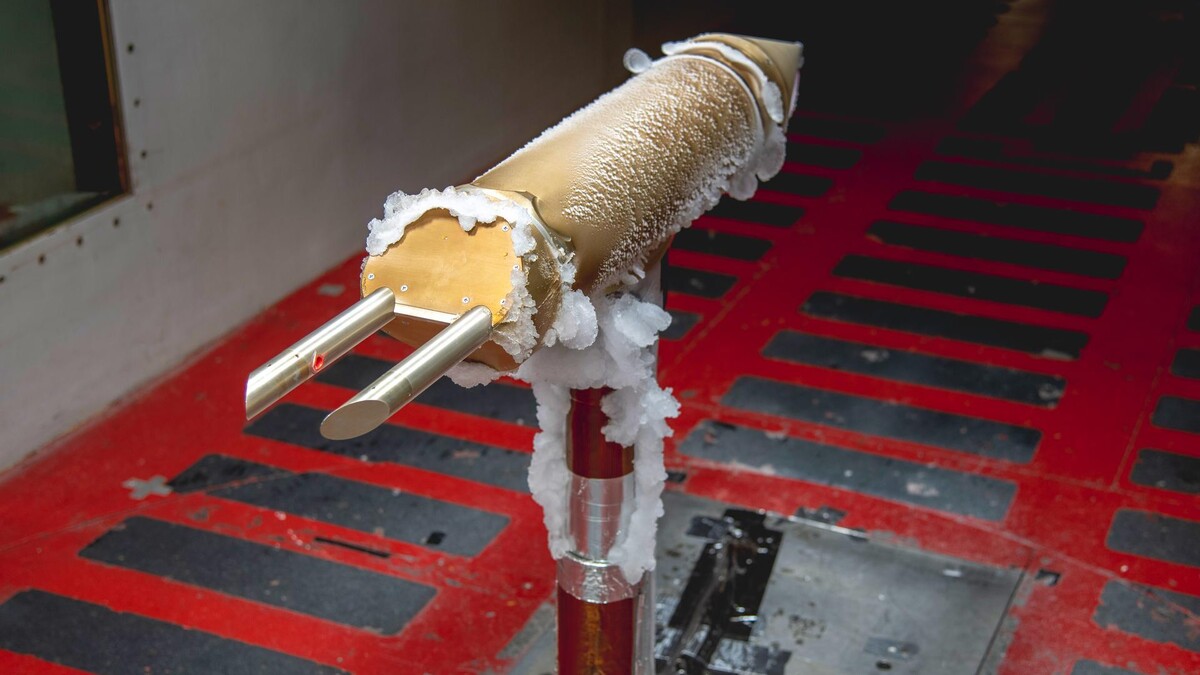
NASA says aircraft are designed for typical icing conditions involving droplets from 2 to 100 microns in diameter. Rarer supercooled large droplets can reach 2,000 microns. In tests conducted from 8 to 11 June at the Icing Research Tunnel in Cleveland, researchers evaluated new probes intended to improve how the tunnel’s experimental clouds are measured.
One set of probes performs real-time analysis of droplets larger than 45 microns. NASA plans to compare that output with post-processed droplet images and combine it with measurements from a different probe for droplets below 45 microns. The purpose is to describe the complete droplet-size spectrum. NASA says detailed analysis of the campaign remains under way and that results will be shared with the aerospace community when complete.
What it means in practice
Dunes Bureau interpretation: the useful industrial development is the measurement chain, not a claim that the icing problem has been solved. A tunnel can produce an impressive coating of ice, but engineering decisions depend on knowing which droplets were present, how their sizes were distributed and whether the instruments agree. Better calibration can make later comparisons between models, protective systems and test runs more defensible.
For manufacturers and suppliers, this separates three stages that are often compressed into one headline. First comes a controlled cloud. Then comes a verified description of that cloud. Only after that can an exposed component or protection system be evaluated against a known condition. Each stage can become a source of uncertainty if its data are incomplete.
The 5 October article does not report certification outcomes, accident-risk reductions, aircraft availability or programme economics. Those claims would require later evidence. The questions worth following are whether the probe methods agree across the full size range, how repeatably the tunnel can recreate large-droplet conditions, and which design tools improve once the analysed data are released.
Sources
NASA Testing Aims at Supercooled Large Droplet Aviation Safety — 5 October 2026 ↗
Sarah Mann · NASA. Accessed 2026-10-06. NASA factual commercial editorial usage and AI source-disclosure guidelines; third-party exceptions checked.